Most RIAs do not have a billing problem. They have a tool-fragmentation problem.
One system handles AUM billing. Another handles subscription billing. A third step is needed for client invoicing or payment collection. By the time the workflow is done, finance and operations teams are reconciling data across multiple tools that were never designed to work together cleanly.
Billing & Payments is meant to simplify that.
TL;DR
- Manage AUM billing and subscription billing in one system.
- Configure fee schedules and assign them at the client level.
- Generate invoices and collect payments by ACH or card.
- Reduce reconciliation work by keeping billing inside the broader operating platform.
- Give admins visibility into expected, collected, outstanding, and failed payment activity.
Why billing and payments are usually split across tools
RIAs often grow into a patchwork of billing workflows.
Percentage-based fee billing lives in one place. Flat-fee or subscription billing lives in another. Client invoicing happens in a third system, and payment collection may be handled separately again.
That creates more than inconvenience. It creates reporting gaps, extra reconciliation work, and a less coherent client billing experience. A client may see one invoice, but the firm may have to check three systems to know what happened to it.
What Investipal handles today
Fee schedule configuration
Billing & Payments is designed to support AUM billing software needs alongside flat and tiered fee structures. That means firms do not have to maintain separate logic for percentage-based and subscription-style billing.
Client fee assignment
Once fee schedules exist, firms still need a clean way to associate them with the right households or clients. Keeping that assignment inside the same system makes revenue operations easier to manage.
Client invoicing
Advisor invoicing software should not live in isolation from the rest of the workflow. Billing & Payments is meant to keep fee setup, invoice generation, and payment collection tied together.
ACH and card payments
Clients can pay through ACH bank transfer or card workflows, which gives firms more flexibility than a purely manual collection process. This is one of the most practical reasons to move away from stitched-together billing operations.
Why one system matters for firms
When AUM billing software, subscription billing software, and client invoicing software all live in different places, finance teams end up doing manual cleanup that no one planned for.
When those workflows live together, firms get:
- less reconciliation overhead
- cleaner invoice and payment workflows
- a more coherent client experience
- better connection between billing activity and operational workflows
How admin visibility works
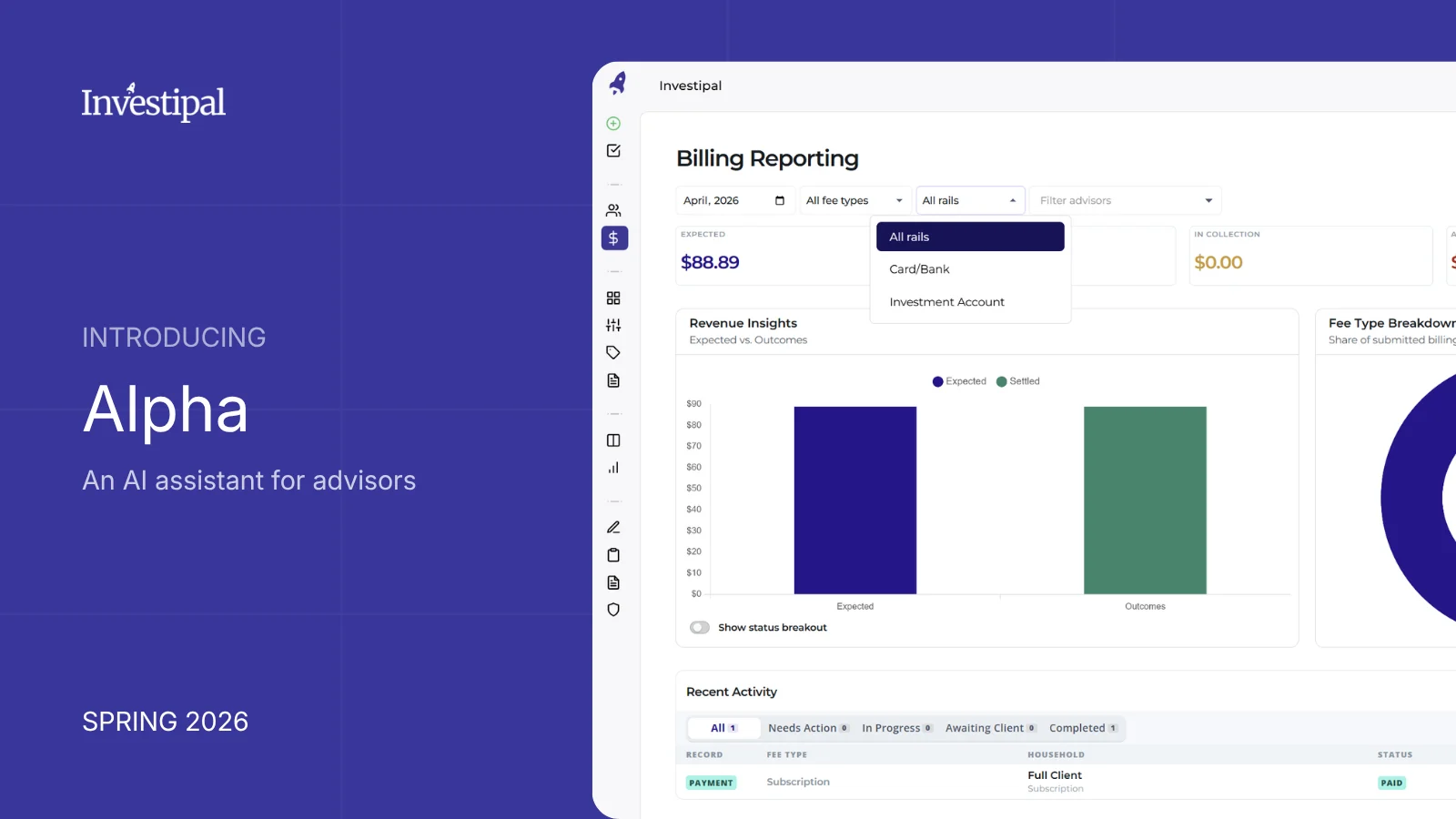
Billing & Payments is not just fee setup. Admins can see what was expected, what was sent to collection, what was collected, what is still outstanding, and how billing breaks down by advisor, payment rail, and fee type.
That matters because billing questions rarely stay in one place. Advisors need client-level history, operations needs collection status, and leadership needs a firm-wide view without rebuilding the numbers in a spreadsheet.
It also makes billing easier to connect to the rest of the lifecycle. A client can move from onboarding into the right billing workflow without the firm recreating the relationship in a separate tool.
FAQ
What billing models does Investipal support?
Investipal supports AUM billing, flat fees, and tiered fee schedules, with billing operations designed for RIA workflows.
Can RIAs handle AUM billing and subscription billing in one system?
Yes. Billing & Payments is designed to help firms manage AUM billing and subscription billing in one system instead of splitting them across separate tools.
Can clients pay by ACH or card?
Yes. Billing & Payments supports ACH and card workflows so advisory firms can collect fees without separating payment collection from the billing workflow.
See Billing & Payments
If your firm is still managing AUM billing, subscription billing, invoices, and payment collection across separate tools, Billing & Payments is the place to start.
For a buyer-oriented evaluation framework, see the RIA billing software checklist.
You can also book a demo to see how billing connects with Alpha inside the broader Investipal workflow.