Investment proposal software turns a prospect’s account data into a branded recommendation: portfolio analysis, a current-versus-proposed comparison, projections, and the reasoning behind the change. Whether it saves you real time depends on one thing, and it is not how the PDF looks. It is whether the prospect’s data flows from statement to signed account without anyone re-keying it along the way.
Most firms shopping for proposal software think they have a document problem. They have an intake, comparison, and compliance problem, and the document sits at the end of it.
TL;DR
- Investment proposal software should connect statement intake, portfolio analysis, proposal generation, compliance documentation, and onboarding. If those live in separate tools, you re-enter the same data at every seam.
- The highest-value feature is clean data flow, not a prettier template. Judge a tool by whether a prospect’s holdings move from their statement into the recommendation and then into onboarding untouched by hand.
- A “proposal generator” is usually just the document step. Full proposal software covers the work before and after it, which is where the time is really lost.
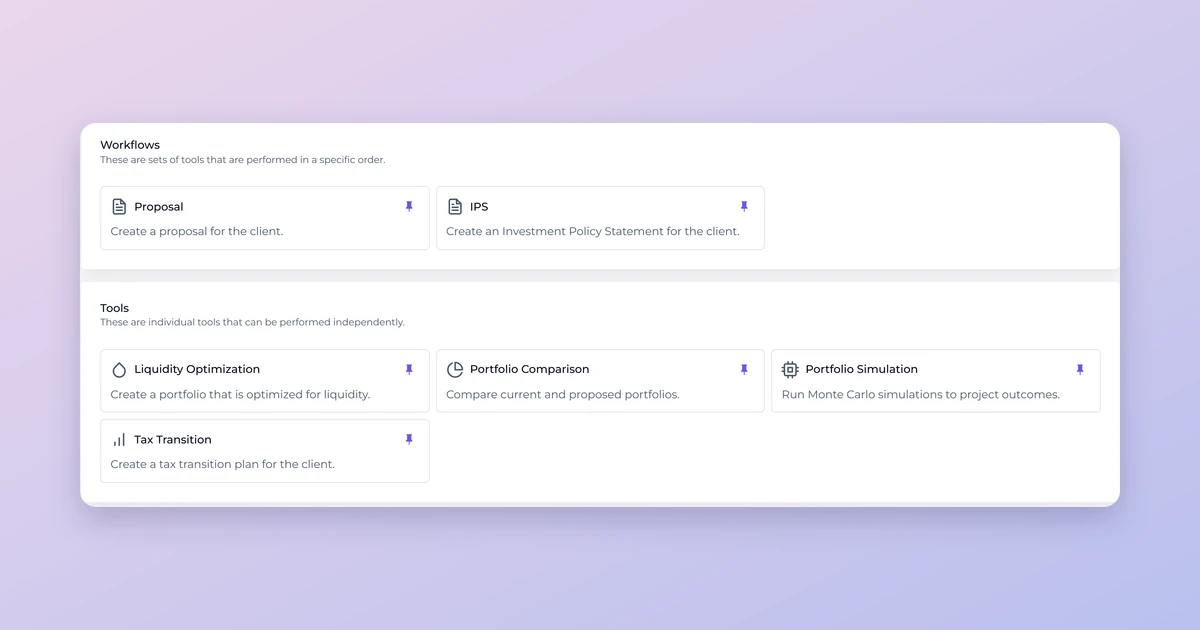
- Investipal runs the full motion: statement scanning (PDF, PNG, JPG, XLSX, CSV, and Plaid), portfolio comparison with fund look-through, stress-testing against 14 named historical scenarios, a Monte Carlo projection, and a drag-and-drop proposal builder with AI-drafted commentary. The same record carries into IPS, onboarding, and billing.
- If you only need a formatted template, a simple document tool is enough. If you want the proposal to sit inside an end-to-end workflow, that is a different category of software.
The bottleneck is everything around the document
Ask advisors how they build proposals today and the answer at most growing RIAs is some version of the same thing: a spreadsheet, sometimes a chatbot, a deck assembled by hand, and no process underneath any of it. When they list their bottlenecks, this is the one they name first.
The sequence that eats the day: a prospect sends a statement, someone extracts the holdings, cleans up the account data, compares the current portfolio against a proposed model, writes the recommendation, prepares the compliance documents, and figures out what happens next. When each step lives in a separate tool, every handoff adds delay and a chance to introduce an error:
- Holdings get copied out of PDFs and into spreadsheets, one line at a time.
- Risk inputs sit in a different system than the recommendation.
- Proposal language is rewritten from scratch for each client.
- IPS and Reg BI support work gets recreated separately.
- Follow-up tasks live in an email thread or a CRM note instead of the workflow.
The most telling symptom is the workaround. Plenty of advisors now assemble proposals in a general-purpose chatbot, client names pasted into the prompt, output printed as a slide deck, knowing full well their compliance team would wince. Smart people route around gaps. But this particular route has no audit trail, puts client details in a public model, and produces a document nobody can reproduce six months later.
Proposal software earns its place by removing those handoffs, not by adding a shinier one at the end.
What to look for in investment proposal software
Use this as a buyer’s checklist. It maps to where firms actually lose time, not to a vendor feature list.
| Capability | What “good” looks like | Why it matters |
|---|---|---|
| Statement intake | Reads the messy files prospects actually send, not just clean CSVs | If holdings still get hand-keyed, the tool cannot save meaningful time |
| Data validation | Confirms each extracted holding is the right security, and flags what it cannot confirm | A proposal built on a mis-identified ticker is worse than no proposal |
| Portfolio comparison | Current vs. proposed across allocation, risk, fees, and concentration | The prospect needs to see why the change is worth making |
| Projections you can defend | Historical stress scenarios and a probability-based projection | ”It might drop” is weak; a specific drawdown number holds up in a meeting |
| Branded, acceptable output | Firm branding, digital acceptance or e-signature | The proposal is a client experience, not just an internal artifact |
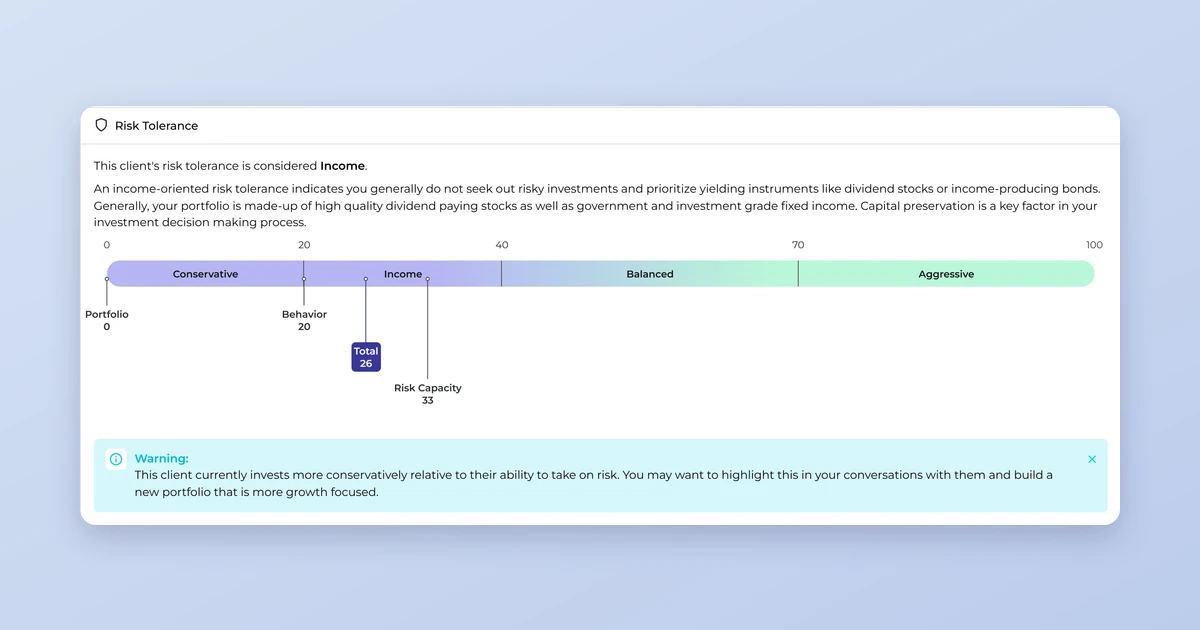
| Compliance continuity | IPS, Reg BI, KYP, and review steps connected to the same data | Otherwise the team re-enters the same information for compliance |
| Onboarding handoff | An accepted proposal starts onboarding, it does not restart intake | Re-collecting data after a “yes” kills momentum and invites errors |
Weight two of these above the rest. Data validation, because extraction accuracy means nothing if you cannot see what the software was unsure about. And onboarding continuity, because if the prospect says yes and your team starts collecting the same information again, the software saved you the easy part and kept the hard part.
How the statement-to-proposal workflow runs in Investipal
Investipal runs the sequence as a six-step proposal wizard: Client Details, Account Transitions, Portfolio Construction, Portfolio Comparison, Portfolio Simulation, and the Proposal itself. Statement in, structured portfolio out, recommendation built on top, proposal delivered, onboarding started.
Reading the statement, and showing its work
Intake starts with automated statement scanning. You can upload a PDF, PNG, JPG, XLSX, or CSV, or link accounts through Plaid, and multi-account statements are supported. The system extracts holdings, transactions, and account details, including embedded fees and advisory costs that are easy to miss by hand.
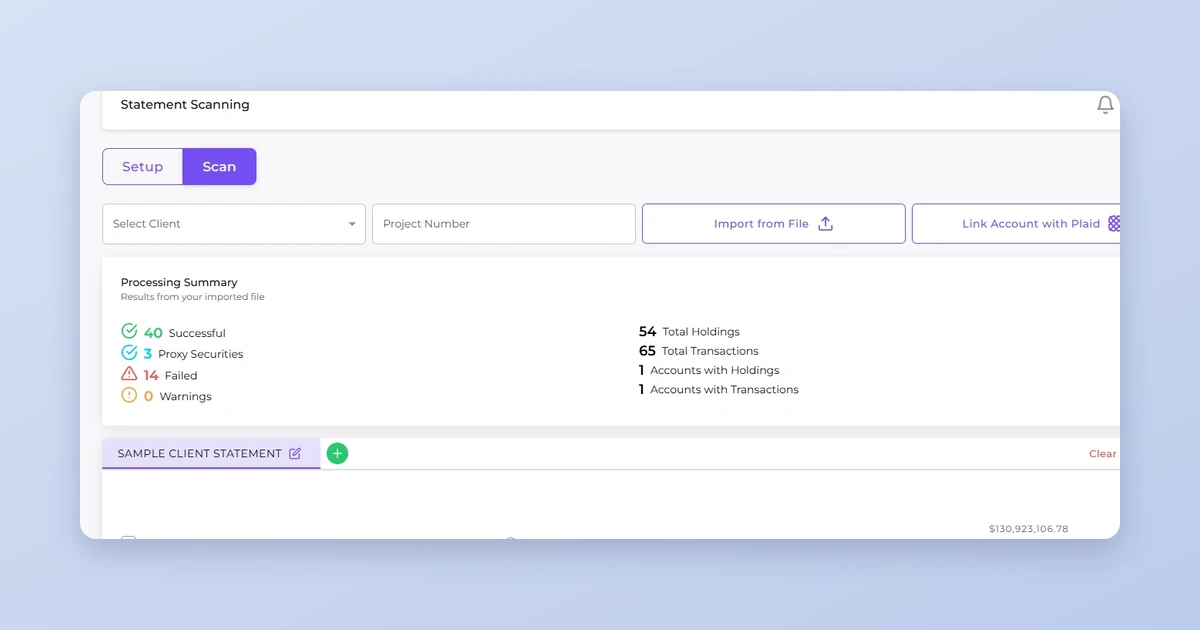
The part that matters for trust is validation. Each extracted holding is checked against Investipal’s security master using price-on-date matching: the system reads the statement date, looks up the security, and confirms the price on that date lines up. If it is uncertain, it retries. If it still cannot confirm, it flags that holding for review rather than guessing. On screen, extracted holdings sit on the left, the original statement on the right, and clicking any figure jumps to its source in the document. In walkthroughs, that source-jump is the feature evaluators single out first. Extraction you can verify beats an accuracy percentage you have to take on faith.
Comparing current versus proposed, with look-through
Once holdings are in, Portfolio Comparison puts the current portfolio next to your proposed models. It leads with four headline cards, current then proposed with the delta, for one-year total return, volatility, max drawdown, and Sharpe. Below that it opens into allocation and sector exposure, income and dividend yield, regional exposure, and a fee analysis that toggles between percentage and dollars.
The section buyers underestimate is Portfolio Concentration. It decomposes funds to their underlying securities and shows true holdings overlap: the look-through analysis that turns “you’re a bit concentrated” into “a quarter of this portfolio is one name once you look inside the funds.” Underneath sit value-at-risk and conditional VaR at 95% and 99%, tracking error, Sortino, and capture ratios, not a color-coded score.
Projections you can put in front of a client
Two tools give the recommendation forward-looking weight. Scenario Analysis runs the portfolio against 14 named historical scenarios, real events like the 2008 Financial Crisis, the 2020 Covid crash, and the 2022 rate hikes, and reports the most severe drawdown and the quickest recovery. Portfolio Simulation runs a Monte Carlo projection, defaulting to 1,000 scenarios over 20 years, and returns success rates against the client’s goals along with best, median, and worst-case ending balances. A prospect worried about downside gets a specific, defensible answer instead of reassurance.
The proposal itself is a studio, not an export button
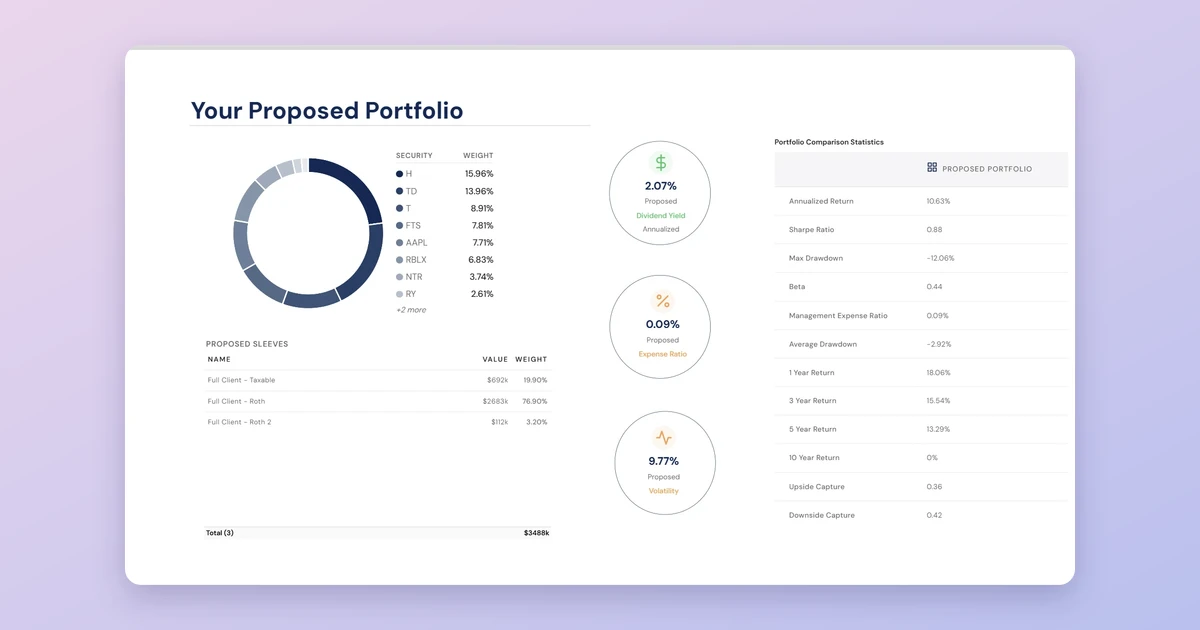
Step six is where most tools stop and Investipal keeps going. The proposal is built in a drag-and-drop studio, not generated as a locked PDF. You compose pages from a component palette: text and stat cards alongside live data components that pull straight from the wizard, comparison charts, allocation donuts, scenario results, the Monte Carlo fan, and holdings. Firm branding, templates, and revision history are built in, and there are official starter templates for a cover page, performance overview, portfolio comparison, Monte Carlo simulation, and a comprehensive analysis.
A “Generate All Commentary” button drafts the narrative across the proposal from the underlying data; you edit it in your voice. The appeal for advisors coming off slide decks is that it keeps the drag-anything-anywhere control and drops the manual assembly. Finished proposals go out as a live client link, a PDF, or a white-label web view on your own domain.
Compliance and onboarding do not restart
The reason to keep all of this in one system is what happens after the prospect says yes. The same client record that produced the proposal generates the Investment Policy Statement from the same goals and holdings, routes documents for built-in e-signature, and moves the household into onboarding through a configurable client portal, with the tasks, disclosures, and payment steps you choose. Advisory billing is tied to the same record through fee schedules.
In one evaluation, a prospect with two decades in the TAMP world stopped mid-demo to call out the onboarding flow as the strongest piece of the platform. The reaction was not about onboarding as a feature. It was about not making the client, or the advisor, redo intake they had already completed to win the business.
Document tool versus workflow tool: how to tell
A document tool helps you create the proposal. A workflow tool moves the client work forward with it. A document tool is enough if your data is already clean, your analysis lives elsewhere, and what you need is consistent formatting. A workflow tool earns its cost when the time sink is intake, comparison, compliance, and onboarding, which for most growing firms is where the hours go.
The test: if you export from the proposal tool and re-import into three other systems, you bought a document tool and you need a workflow.
When Investipal is, and is not, the right fit
Investipal fits firms that want the proposal connected to the rest of the client lifecycle: cutting manual statement entry, documenting recommendation rationale, generating the IPS from the same workflow, and starting onboarding the moment a prospect accepts. Each module runs on its own, so a firm that only needs the statement scanner or the comparison engine can adopt one surface without swallowing the platform.
It is the wrong fit if all you want is a static template to drop numbers into; a lighter document tool will be simpler and cheaper. And if you are weighing a specific incumbent, read a direct breakdown like Investipal vs. Nitrogen (Riskalyze) rather than a generic feature grid.
Proposal software should not end when the file is finished. It should tell your team what happens next, and carry the client there.
See the workflow
The best way to evaluate investment proposal software is to watch a real statement move through to a delivered proposal and into onboarding. Explore Proposal Generation, see the full How It Works flow, or book a demo to run the statement-to-proposal workflow on your own client scenarios. You can also start with Investipal directly.
FAQ
What is investment proposal software?
Investment proposal software helps financial advisors turn a prospect’s account data into a branded recommendation: portfolio analysis, a current-versus-proposed comparison, projections, and the rationale behind the change. The most useful tools connect the proposal to statement intake, risk profiling, IPS and compliance documentation, and onboarding, so the same data flows through instead of being re-keyed at each step.
What should financial advisors look for in proposal generation software?
Look for statement intake that reads the files prospects actually send, a comparison that covers allocation, risk, fees, and true concentration, projections you can defend in a meeting, branded output clients can accept digitally, and a clean handoff into IPS and onboarding. The single most important question is whether prospect data flows through the whole workflow or has to be entered again for each tool.
Is a proposal generator the same as investment proposal software?
Not quite. A proposal generator usually refers to the document step: it formats inputs you already prepared. Full investment proposal software also covers the work before and after the document, from reading a brokerage statement to comparing portfolios to moving an accepted proposal into onboarding. The document is one step of a longer motion, and that is where the time is usually lost or saved.
How is Investipal different from a standalone proposal builder?
Investipal runs the whole motion in one place. It reads statements in PDF, PNG, JPG, XLSX, CSV, or through Plaid, validates each holding against a security master, compares the current portfolio against your proposed models with fund look-through, stress-tests against named historical scenarios, and runs a Monte Carlo projection, then assembles all of it into a branded, drag-and-drop proposal with AI-drafted commentary. The same client record carries into IPS, e-signature, onboarding, and billing.
Can advisors build proposals with ChatGPT or PowerPoint instead?
Some do, and it is a warning sign rather than a solution. Advisors have described building proposals in a chatbot and pasting the output into PowerPoint because nothing else fit their workflow. It works until it does not: there is no audit trail, client details get pasted into a general-purpose model, and the document cannot be reproduced or defended later. Purpose-built proposal software keeps the data governed and the output consistent.